The Soviet Agricultural Subsidies Covered the Deficit in 1989
Less known consequences of Byung-Yeon Kim's 2002 paper

I talked about this paper before but I am still unsure about posting about this result because I didn’t really verify it independently in full. I will come back to it in the future.
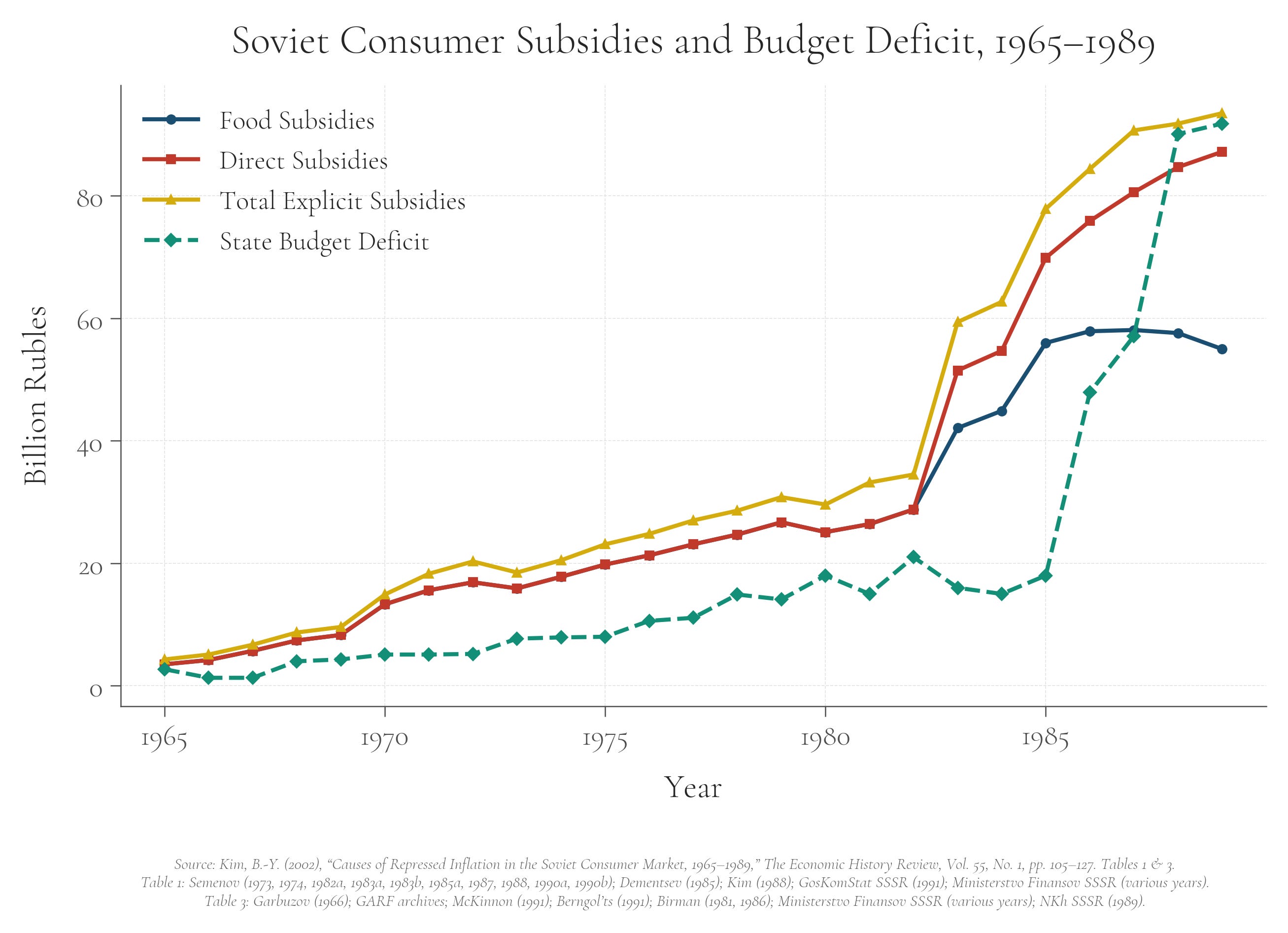
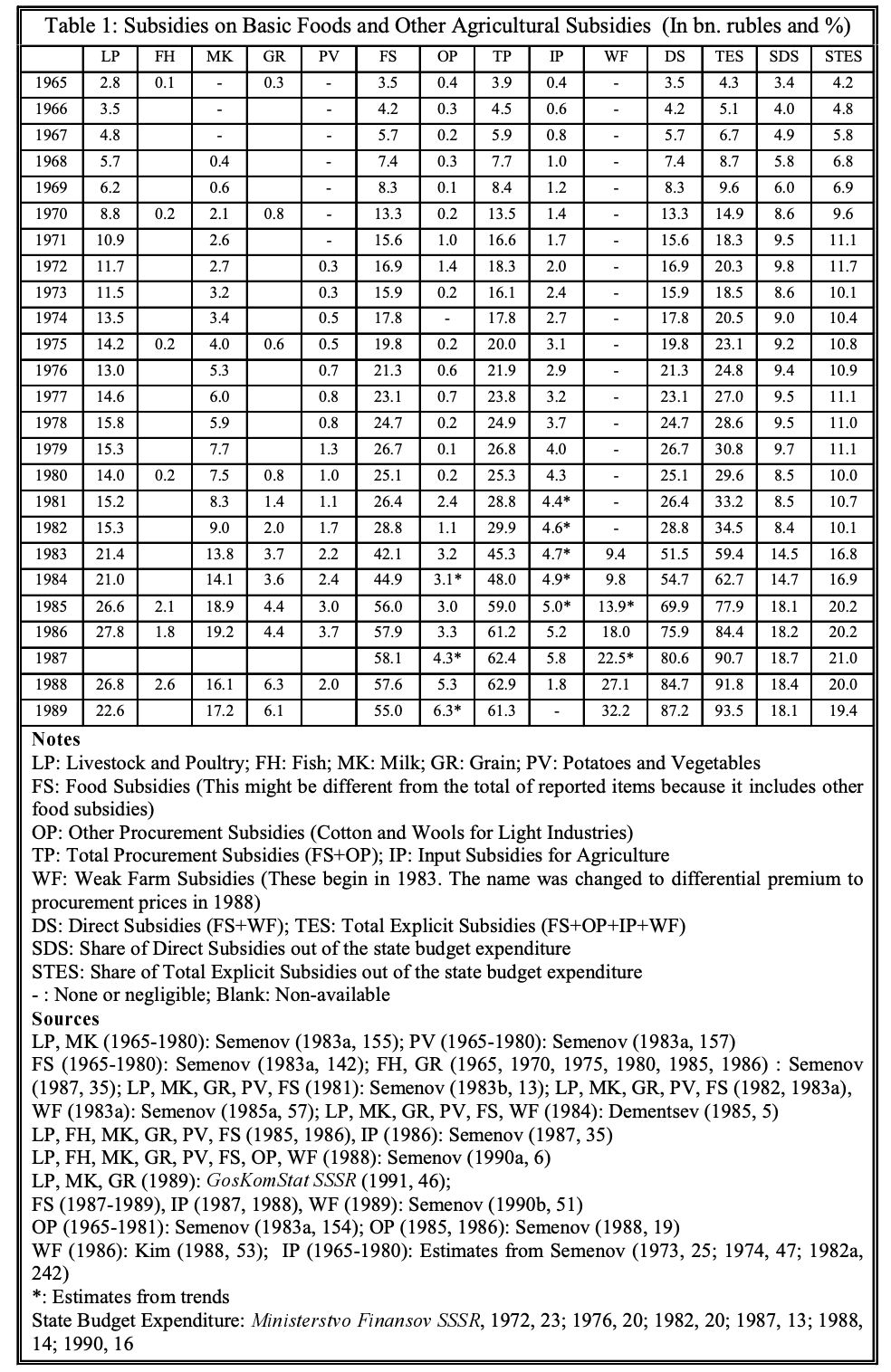
People who know something about the Soviet Union know that it had fiscal problems in the last years of its existence. People with more knowledge know that the country maintained a very extensive system of food subsidies. But an extremely surprising result on the topic was produced by Byung-Yeon Kim’s “Causes of Repressed Inflation in the Soviet Consumer Market, 1965–1989: Retail Price Subsidies, the Siphoning Effect, and the Budget Deficit”, which tried to estimate the value of explicit agricultural subsidies. If you accept the values produced in the paper, agricultural subsidies fully covered the Soviet deficit by 1989, and the country would not have had a fiscal crisis if it had a clearing market in agricultural goods ie raising retail prices towards procurement prices
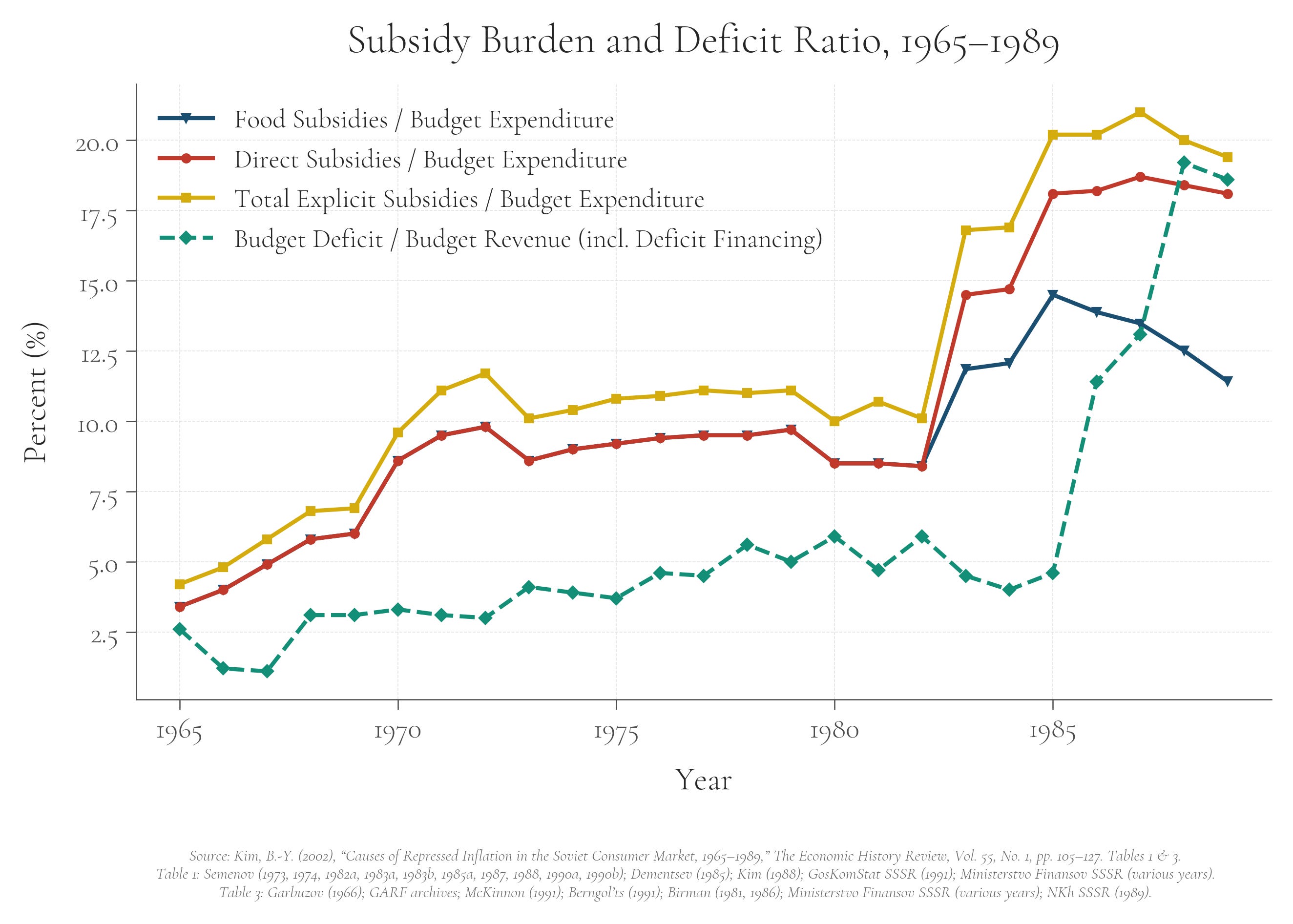
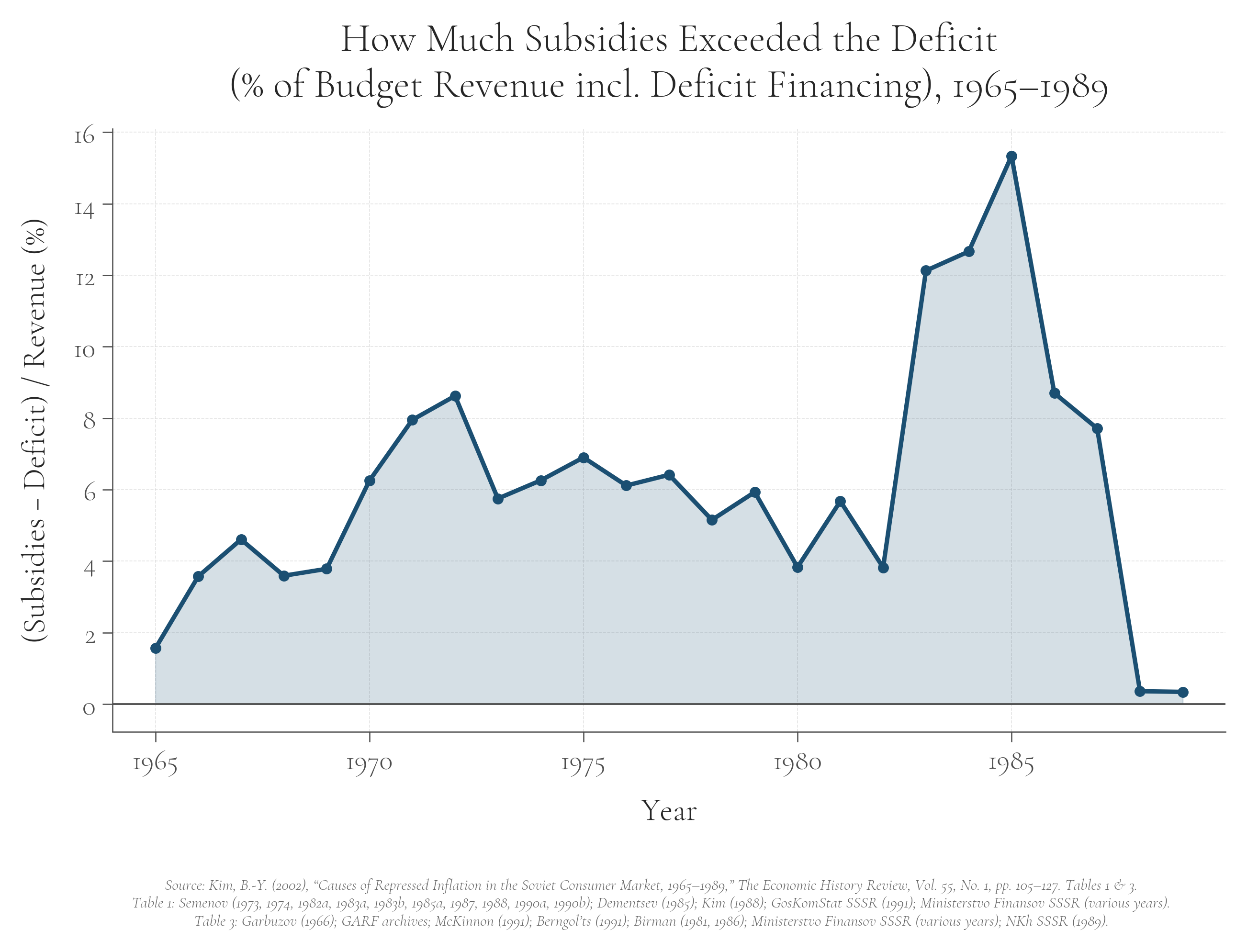
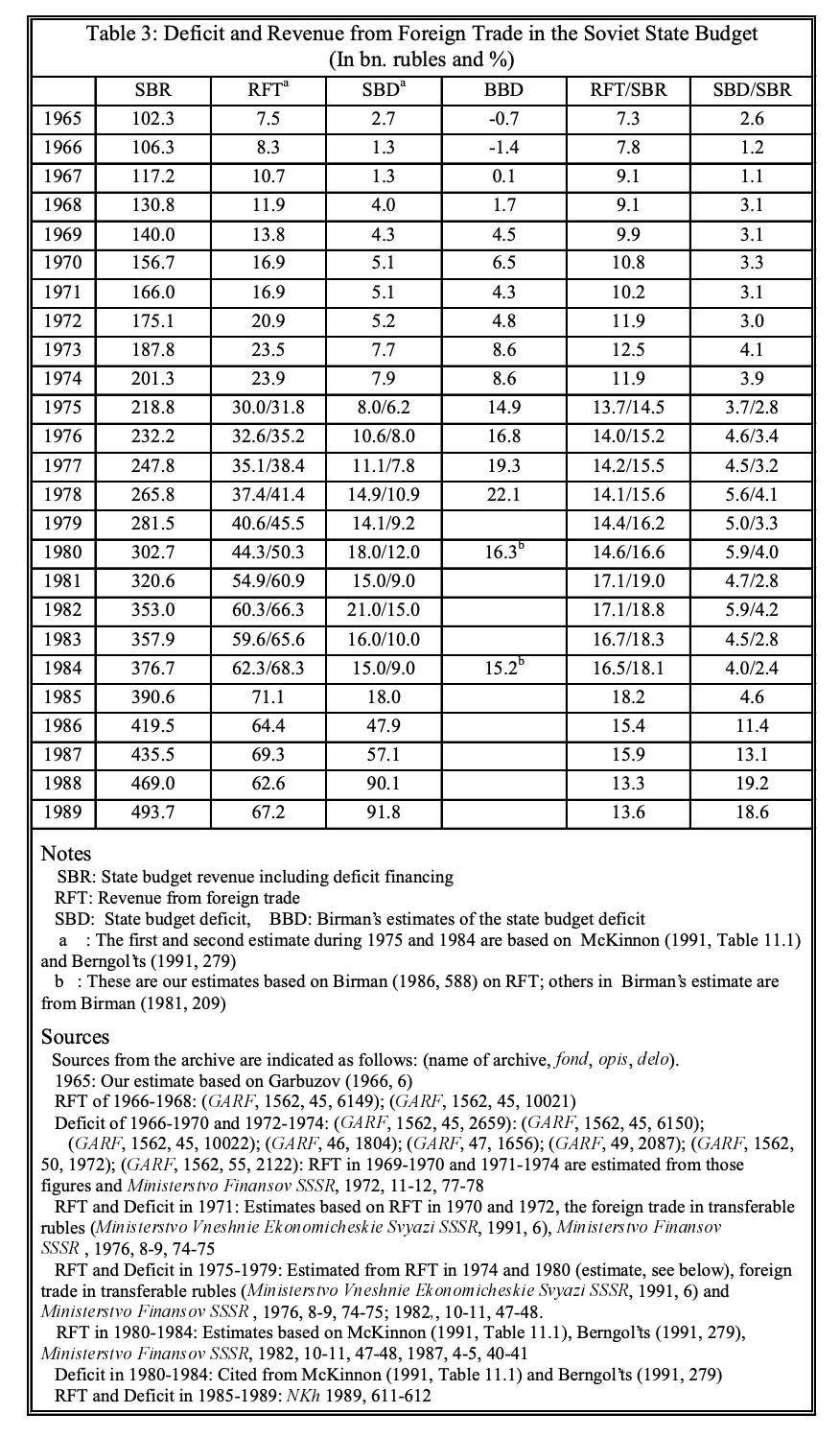
The mechanism is straightforward. The Soviet state bought food from farms at high procurement prices but sold it to consumers at low, politically fixed retail prices but it would need to compensate it to producers to keep them operating. Remember, price controls are not free. By 1989, this difference amounted to 93.5 billion rubles, or about 19% of state budget expenditure. Meanwhile, the state budget deficit stood at 91.8 billion rubles. The subsidies exceeded the deficit by 1.7 billion rubles.
This means that even in the worst fiscal years of the Soviet Union in which the country was leading to collapse and disintegration, simply eliminating agricultural subsidies, letting retail prices rise to cover procurement costs, would have closed the deficit. No other reforms would have been needed to balance the budget if we really believe Kim. Of course, eliminating food subsidies was politically explosive: everyone in the government had nightmares about Poland and Novocherkassk. This could only have been done by a person of the capitalist breed. As Nove (1986) noted, “The leadership plainly attaches great political importance to [retail price stability].” (cited in the paper).
The paper has other relevant results but I will concentrate on this one as for now.
Sources:
Kim, Byung-Yeon. “Causes of Repressed Inflation in the Soviet Consumer Market, 1965–1989: Retail Price Subsidies, the Siphoning Effect, and the Budget Deficit.” The Economic History Review 55, no. 1 (2002): 105–127.
I'll have to look at the actual references in the piece, but I'd guess it's quite hard to disaggregate food subsidy given they were folded into so many institutional settings and ministerial operations with direct relationships to producers. What I'm saying is that looking at direct subsidies to consumers buying from food stores might be less relevant than the author realises given that a significant part of consumption beyond staples takes place via credentialized access to workplace, etc.