Indicies, Benchmarks, PPPs, and Miracles
Japanese Occupied Korea, Japan and the Soviet Russia

Economics is a science about indices. We are trying to reduce multidimensional data into a single index to provide us with instruments of comparison of welfare, production capacities and so on.
Money is also such an index that shows information about scarcity (differences between supply and demand) for a particular item, its substitutes and which allows us to aggregate the information by just adding prices together.
The main task in a comparison of productive capacity and quality of life between countries is normally trying to deflate nominal wages or national incomes by some deflator producing “real” income. A deflator is produced by combining quantities multiplied by prices from different periods.
It’s especially problematic in a study of socialist economies that lack market prices which, mixed with lacking data and peculiar methods of statistical collection, makes it really hard to compare them to other places and to compare them to themselves through time.
Other metrics of international comparisons like life expectancy or age standartized mortality are also indices.
Here we will compare the GDP per capita indices for the Soviet Russia, Colonial Korea and Japan (one can produce a narrative if we lived in better times, but our troubled times are not allowing for such things) in the period 1913-1940. 1913 is a normal start of the time series of the Soviet Russia and 1910 about Colonial Korea, for obvious reasons in both cases.
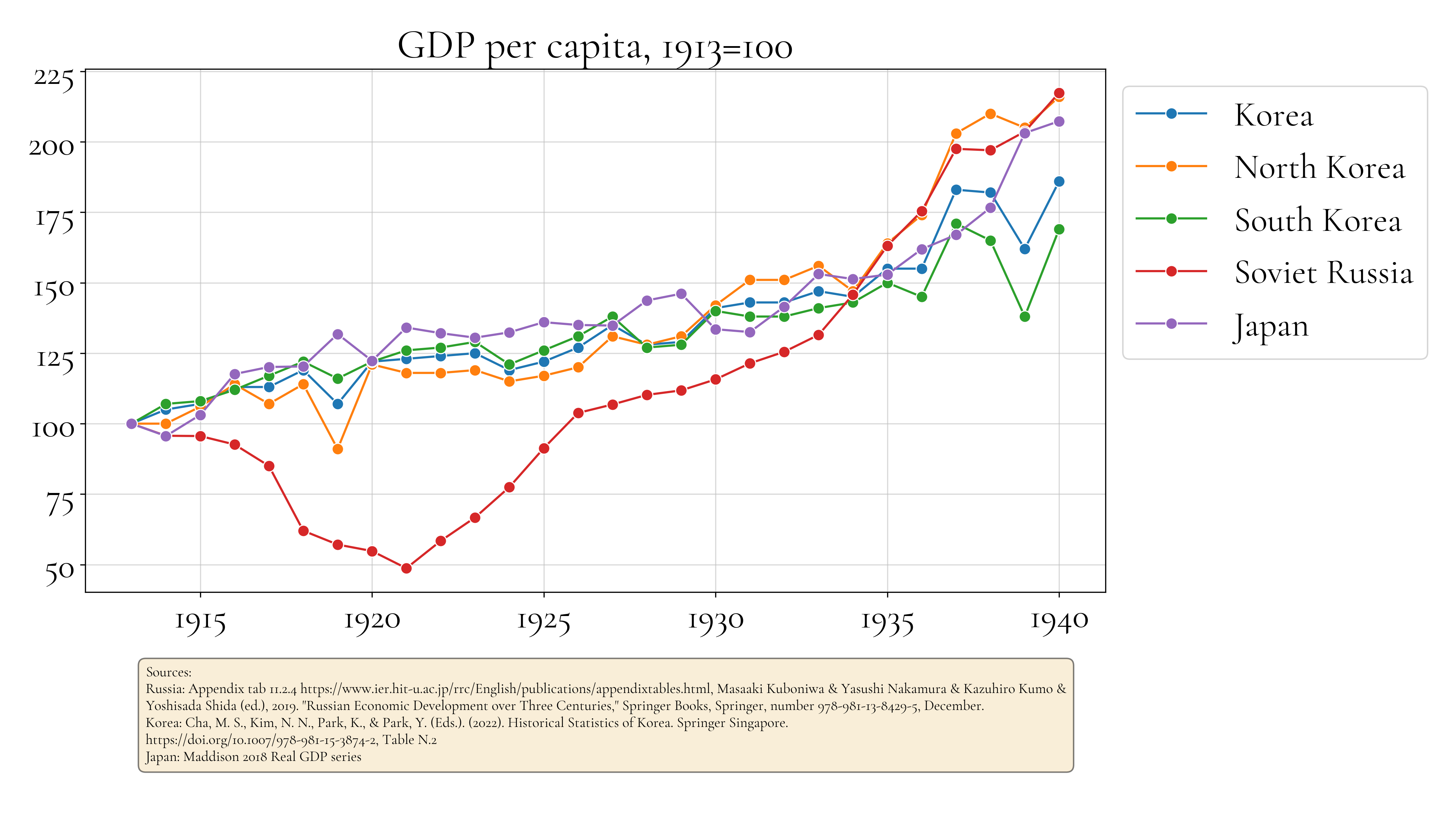
Sources:
Russia: Appendix tab 11.2.4 https://www.ier.hit-u.ac.jp/rrc/English/publications/appendixtables.html, Masaaki Kuboniwa & Yasushi Nakamura & Kazuhiro Kumo & Yoshisada Shida (ed.), 2019. "Russian Economic Development over Three Centuries," Springer Books, Springer, number 978-981-13-8429-5, December.
Korea: Cha, M. S., Kim, N. N., Park, K., & Park, Y. (Eds.). (2022). Historical Statistics of Korea. Springer Singapore. https://doi.org/10.1007/978-981-15-3874-2, Table N.2
Japan: Maddison 2018 Real GDP series (Maddison 2018 has real national accounting series, it makes it possible to compare growth rates).
https://www.rug.nl/ggdc/historicaldevelopment/maddison/releases/maddison-project-database-2018?lang=en